HousingPolitics

Homelessness in New York City At An All Time High And Rising With No End in Sight

Read the statement below from Coalition for the Homeless

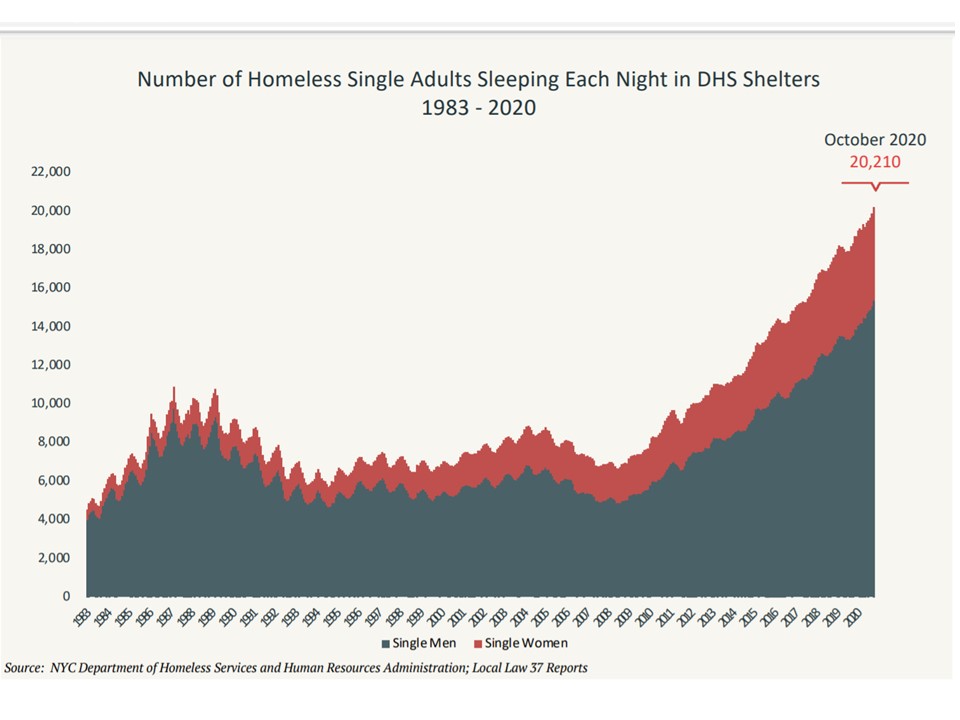
The Campaign 4 NY/NY Housing unveiled a grim and record-setting milestone among homeless single adults. For the first time, the number of single adults sleeping each night in DHS shelters, including safe havens and stabilization beds, climbed to more than 20,000 (20,210). With more single adults sleeping in shelters than at any time in history, advocates urged Governor Cuomo to prioritize permanent supportive housing in a press conference today.

Between May and August, the age-adjusted COVID-19 mortality rate for homeless New Yorkers sleeping in shelters was 78 percent higher than the citywide average, underscoring the fact that housing is health care. It is crucial that Governor Cuomo follow through on his commitment to create 20,000 units of supportive housing, of which only 6,000 have been funded so far. Despite the unprecedented need, only one in five applicants approved for supportive housing is able to secure a placement and move out of a shelter or off the streets into a home of their own.
“If there is one thing the pandemic has taught us, it is that housing is health care. Our homeless neighbors need the safety and stability of a home. Governor Cuomo knows how life-changing supportive housing can be for the most vulnerable New Yorkers – now we need him to follow through on the promise he made five years ago to fund 20,000 units of this desperately needed housing,” said Giselle Routhier, Policy Director of Coalition for the Homeless.

Failure to prioritize long-term supportive housing investments in the short-term will hold dire economic consequences. Numerous studies have shown that reducing the number of chronically homeless individuals in communities saves money by disrupting a costly cycle of housing instability for those shuttled among institutions including shelters, hospitals, and jails.

“New York has been facing a homelessness crisis for years, but the pandemic has accelerated it to unprecedented heights as we now have more than 20,000 single adults sleeping in NYC shelters each night,” said Laura Mascuch, Executive Director of the Supportive Housing Network of New York. “To meet the scale of this challenge, we need Governor Cuomo to make good on his historic pledge to create 20,000 supportive apartments by committing to fund the remaining 14,000 homes in this year’s budget. This would help end chronic homelessness and create affordable housing – all while putting New York on the path to recovery by saving money otherwise spent on crisis interventions, creating much-needed jobs, leveraging private capital, and spurring investment in our communities.”

“Across New York, the need for supportive housing is striking and disproportionate for people of color who have been most impacted by COVID-19 and homelessness. A long-term funding commitment is crucial to the continued development of supportive housing. CSH looks forward to the Governor fulfilling his commitment to fund 20,000 units of supportive housing in the State’s upcoming budget,”said Kristin Miller, Director of the Corporation for Supportive Housing.

“The pandemic has only exacerbated the existing need for supportive housing in New York. Not only is safe, stable housing a means to improve health outcomes, it has literally meant the difference between living and dying for thousands of New Yorkers during this health crisis. So far, sheltered New Yorkers have died from COVID-19 at a rate 78 percent higher than those who are stably housed. Housing is health care, and supportive housing saves lives,” said Cal Hedigan, CEO of Community Access.

“These astronomical numbers that indicate such an increase in single adult homelessness, are a testament to the importance of adequately funding Mental Health Housing programs across New York State,”said Sebrina Barrett, Executive Director of the Association for Community Living. “Our members’ staff will continue to do what they always do, and have been doing especially during this pandemic–find a way to make it work and offer as much care as they can, despite chronic underfunding. But the aforementioned statistics tell us that something needs to change.”

“The COVID-19 pandemic has underscored once again the vital role supportive housing plays in keeping vulnerable populations safely housed and safeguarding our public health,” said Judi Kende, Vice President and New York Market Leader of Enterprise Community Partners. “Supportive housing is an integral solution to homelessness, which had already reached crisis levels in New York before the pandemic. It’s even more important now to ensure that critical resources are available and accessible for the people who need them most.”

“In a moment of historic homelessness and suffering, we cannot allow politics of scarcity and austerity to dominate our state. New York has the resources to overcome the pandemic and rebuild stronger by taxing the ultra-rich, so that every New Yorker has access to the housing, services, and care they need. The Governor must follow through and fund the remaining 14,000 supportive housing units he promised homeless New Yorkers in 2016,” said Paulette Soltani, Political Director of VOCAL-NY.

RELATED CONTENT

Privatization Of NYCHA: Blueprint Plan Looks Like A Dishonest Attempt To Hand Over Reigns To Financial Elite Disguised As A Public Trust

The City’s Three NYCHA Plans That Will Privatize Public Housing
Continue reading

Features

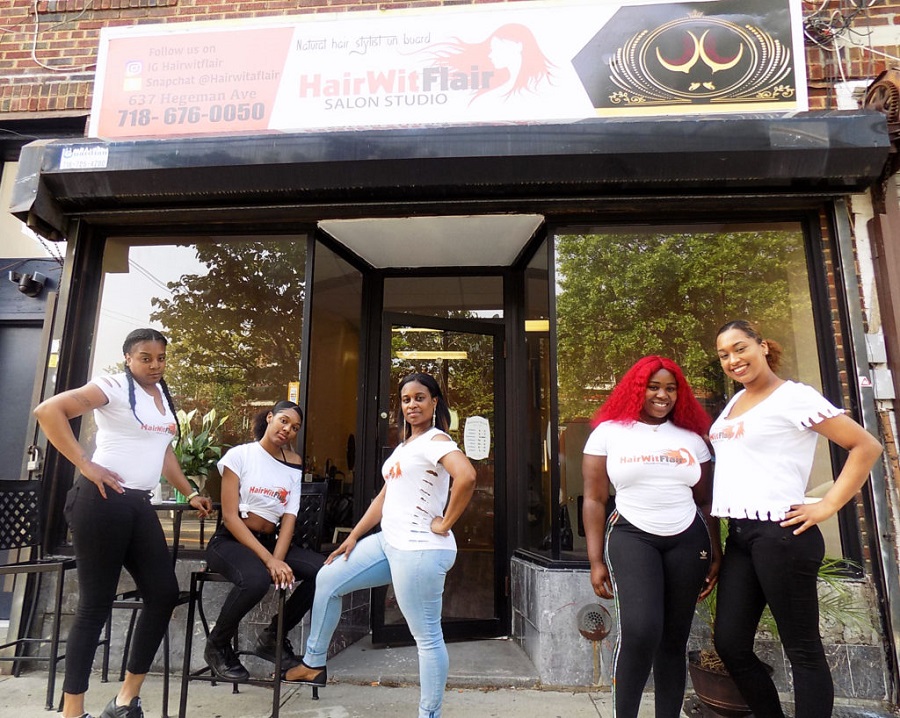
Real PEOPLE of ENY: Latisha Campbell, Salon Owner Brings Resiliency and Hair Flair to East New York

Small businesses are often cited as the backbone of the American economy, and in African American communities, this couldn’t be even more true. However, there is something special about the hair salon. It’s not only a place that offers the vital service of hair care, but it’s also a site where communities and bonds are built.

Latisha’s Childhood Dream

Latisha Campbell, who is East New York-grown, is the owner of HairWithFlair in Brooklyn. A licensed cosmetologist and instructor, her IG page displays examples of her creative and exceptional work, inspirational advice, and the occasional promotion of a natural hair care webinar.

HairWithFlair started as a childhood dream. The sentiment deepened when she first moved to New York as a young child and lived on Lott Ave. in Brownsville in Brooklyn.

Dampened Dreams

A graduate of the Hair Design Institute and Kingsborough Community College, Campbell put her dreams into action by pursuing her cosmetology license and a two-year business degree. Nevertheless, school nor any licensing could prepare anyone for the struggles 2020 has brought to small businesses like hers:

“During this pandemic, my business has decreased tremendously. I am servicing one to two clients a day, and that isn’t every day. Back in June, when the quarantine was lifted, the business was great, but it slowly started to decrease,” Campbell then added, “I’ve seen the shift starting about two months ago. I have been seriously thinking about shutting down because of this.”

Campbell has received some federal pandemic-related funding, but the funds are running out.

“It’s just not enough to cover all of my expenses…”

Battling Back

Campbell has owned and operated salons in North Carolina through partnerships, taught cosmetology, and even participated in hair battles. Still, this particular fight has left her and many others struggling to find new strategies to supplement income.

Nevertheless, much like those hair battles, Campbell hasn’t given up the fight. Campbell is still accepting clients and is also looking for two stylists to rent chairs to for $550 a month each.

Displaying the Resiliency of East New York

For two years, Campbell has served East New York community residents, and she hopes to continue to do so. The knowledge she possesses has allowed her to bypass the salon chair to offer education and hair care help online. Her @HairWithFlair Instagram profile page is a wealth of knowledge about hair care education and a spotlight on all the work Campbell has done for clients in the community.

Whether digitally or in-person, Campbell is offering a valuable service in East New York, but she is in the battle to stay open like many other small business owners across the country. Each day is a testament to the strong spirit of entrepreneurism that makes up the fabric of this country and the people of East New York.

Again, Campbell is currently taking new clients at her HairWithFlair Salon Studio at 637 Hegeman Ave Brooklyn, NY 11207. If you are looking for a stylist, and want to support an entrepreneur in the community, be sure to look her up. You can Call for an Appointment at 718.676.0050.

Continue reading

DevelopmentHousingPolitics

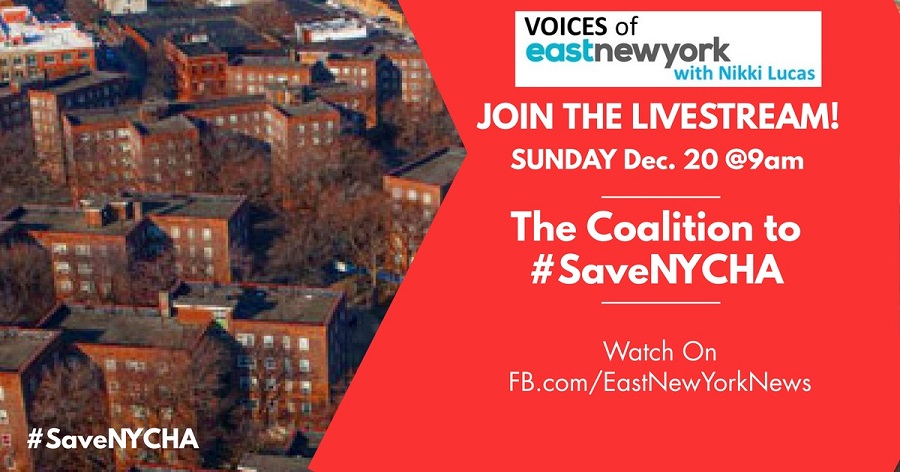
Join The Coalition to Save NYCHA from Private Developers Sunday Dec. 20 at 9am on VOICES of East New York with Nikki Lucas To Stop the Displacement of Tenants

Based on past segments about the Privatization of NYCHA, on VOICES of East New York with Nikki Lucas, it has become crucial that a true Coalition to #SaveNYCHA had to be formed to stop the city from handing over its housing portfolio to private developers.

Kristen Hackett of the Justice for All Coalition has been a guest multiple times on VOICES of East New York with Nikki Lucas, to explain in detail how the RAD Program is absolutely a privatization plan and the Blueprint Plan is a Dishonest Attempt To Hand Over Reigns To Financial Elite Disguised As A Public Trust.

This Sunday December 20 @9am the discussion on VOICES of East New York with Nikki Lucas will focus on the Coalition to #SaveNYCHA and the importance for it to be completely independent of current Council and Assembly members who sat around for the past 15 years while the bad deed was being done. The tenants were left in the dark until EastNewYork.com informed the community about the privatization, along with Nikki Lucas discussing it on VOICES of East New York. And then East New York News exposed the elected officials as they scurried in an attempt to defend their non-actions, which they are still trying to do. There is no defense for being silent for 15 years while developers were working to get their hands on NYC’s real estate portfolio.

The community still needs to be educated on what this all means and how it will impact not only the tenants in NYCHA, but tenants throughout East New York. If you live in East New York you already know that Storage facilities have opened up in every section of the neighborhood and hotel shelters are opening at a rapid pace.  The local elected officials have not tried to stop storage facilities from opening nor have they tried to stop hotel shelters from popping up all over East New York. The only reason not to fight against storage facilities and hotel shelters is the fact that the elected officials must have already known that tenants in East New York were going to be displaced and they would need a place to store their belongings while they are moved to shelters.

Join this week’s discussion on VOICES of East New York with Nikki Lucas to find out how you can help to stop the privatization of NYCHA, while still working on a solution to have NYCHA developments completely renovated without raising rents or displacing current tenants who lived in NCYHA through the hard times. In the meantime Sign the Petition to #SaveNYCHA

Join the discussion at FB.com/EastNewYorkNews


Continue reading

Development

East New York Organizations Rally Against ReZoning Development That Has Been Empty On Investment and Jobs Promises

See the video below.

The Coalition for Community Advancement, along with BocNetwork, North Brooklyn YMCA, CHLDC, Universe City NYC, United Community Centers, Just Hauling, Local Development Corporation of East New York rallied over the weekend, demanding immediate accountability and transparency from the City and the Economic Development Corporation (EDC) on their unfulfilled commitments to invest $16.7 Million into the East New York Industrial Business Zone (IBZ) and the creation of 3,900 jobs. These jobs and investment were promised back in 2016, through the East New York Rezone. Now, 4 years later, we should have seen $6,680,000 of those investments and 1,560 new jobs. To date, we have not seen either of these commitments.

While developers are currently experiencing the benefits of the increased density made available through the rezone, the community has not received the benefit of jobs promised. We are in a pandemic that has further exacerbated the unemployment and underemployment crisis of our community. Where are the 3,900 jobs? The organizers are demanding the EDC and the City to answer for the promises they made to the East New York community.

The key demand is economic justice. The organizers are demanding 3,900 local, livable-wage paying jobs, and transparency, accountability, and action from the EDC and the City.

Community Testimonies:

“The City kept their promises to developers, but broke their promise to constituents…nothing is affordable without a job” – Brother Paul Muhammad, Coalition for Community Advancement Steering Committee member, member of Brooklyn’s Muhammad Mosque 7c, East New York Homeowner

“Real estate developers have been given opportunities to build wealth off our communities, but what do we get? Where are the opportunities for our workers and our families? The East NY rezoning promised 3,900 jobs and there has been a failure to deliver. We demand good jobs at thriving wages for the people of East NY!” – Sandy Nurse, Co-Director Just Hauling

“There is NO Distinction between Economic Injustice and Racism. We need to start putting Community Benefit at the Core of our Economic Strategy in order to ensure economic and social mobility for the Entire Community of East Brooklyn. The City, at every level, should be working in Solidarity with the People and Organizations currently existing in East Brooklyn in order to succeed — Not Against Us. Preserving and Strengthening our IBZ should be decided upon by the Community and not left in the hands of the Economic Development Corporation, The Department of City Planning and this or any administration to Dictate. It’s time we begin aligning our economic and ecological perspectives and reduce the amount of broken promises that are fed to the public. We need to start promoting and advocating for policies and zoning that protect our communities health, and environment for future generations to come.” – Brittany Markowitz, Co-founder & CFO of Universe City NYC, and Owner of Maverick Scrap Metals Ecology

“At the heart of any at-risk, under-served community, you will find high unemployment and underemployment. Therefore, to transform East New York and alike communities, local workforce development initiatives must be the centerpiece. Today, we hold the De Blasio administration responsible for an unkept promise to increase employment by 3,900 individuals. Local stakeholders agreed to 6,000 new units of housing for 3,900 new jobs. To this point, the only way to achieve 3,900 new jobs is to develop local assets like, Broadway Junction, through a community based process. Show me the jobs!” – Bill Wilkins, Director of Economic Development at Local Development Corporation of East New York

“Our neighborhood was one of the hardest hit in the current COVID 19 pandemic. Many businesses are closed and unemployment is hitting record levels. Typically, our unemployment rate is 5-10% higher than the city average and the current crisis has only exacerbated this unjust disparity with an unemployment rate nearing 25%. I am here to highlight a local concern of neighborhood advocates who have organized the Coalition for Community Advancement. The group was first formed when the neighborhood was facing a massive rezone which occurred in 2016. I am here to say that the agreements made in that rezone process have not been kept. Developers are experiencing the benefits of the increased density, but the community has not received the benefit of jobs promised. We were promised 3,900 jobs as part of $16.7 Million dollar investment in the local IBZ. I am here to ask, “Where are the 3,900 jobs?” We need EDC and NYC to answer for the promises they made to our community.” – Lowell J. Herschberger, East New York Resident, leader at the Cypress Hills Local Development Corporation, and member of the New York City Employment and Training Coalition.

Continue reading

Health

What Foods Should a Diabetes Diet Include?

Healthy Living Content Sponsored by RiseUp ENYJoin the Community Health Survey


If you’ve been diagnosed with diabetes, you already know it’s important to keep your blood sugar (glucose) levels within a target range. Glucose levels that are consistently too high can lead to serious health conditions such as heart disease, stroke, nerve damage, loss of vision or kidney disease.

Checking your blood sugar level according to your doctor’s instructions is necessary. But when you have diabetes, it’s also important to follow a healthy eating plan to help keep your blood glucose within a normal range. Eating too many high-sugar or high-fat foods may cause blood glucose levels to spike.

No foods are completely off-limits, even when you have diabetes, but it’s best to build your diet around foods that are high in nutrients while being low in sugar, fat and calories.

Here are 5 tips for helping to plan your diabetes diet:

  • Understand carbohydrates. Your body needs carbohydrates, but it’s important to know the difference between simple carbs and complex carbs. Complex carbohydrates contain dietary fiber, which helps to keep your blood sugar level steadier as they are digested. Vegetables, fruits, whole grains (like quinoa, brown rice and oatmeal), nuts and legumes (like beans and peas) are complex carbs. Choose these whenever possible instead of simple carbs such as white bread, white rice, soda, cookies, fruit juice and many breakfast cereals.
  • Get enough protein. Choose from chicken, fish, beef, pork, eggs, dairy, beans, nuts and soy products. When possible, select low-fat protein sources, such as skinless chicken breast or fish. Plant-based protein sources, such as beans or nuts, are also good choices and include dietary fiber. Limit high-fat meats and full-fat dairy.
  • Pay attention to fats. Some fats can increase the risk of heart disease or stroke. Since diabetics already have a higher risk for these conditions, it’s important to cut down on saturated fat (found in beef, bacon, high-fat dairy and coconut oil), trans fat (found in processed snacks and baked goods) and dietary cholesterol (found in high-fat animal proteins and egg yolks). Instead, opt for “good” fats, such as avocados, nuts and olive oil. Keep in mind that even good fats are calorie-dense so keep portion sizes in check.
  • Eat sweets sparingly. It’s difficult to completely eliminate sweets and treats from your diet, but when you eat them, stick to a small portion and savor it. Also pay attention to how specific foods seem to affect your blood sugar and try to steer clear of ones that quickly make your blood sugar spike.
  • Don’t forget about drinks. You may be surprised by how much sugar and how many calories you consume from drinks. Stick to low-calorie and low-sugar drinks as often as possible such as water, seltzer, unsweetened tea or coffee. Try to avoid soda, juice, energy drinks or that delectable-looking concoction at the local coffee shop.

What you eat can affect how you manage your diabetes, but when you eat is also important. Keep to a regular schedule of meals and snacks, eating around the same time each day. This gives your body time to effectively use the insulin it produces or that you administer.

Since it can be difficult to monitor your diet, especially if you’ve only recently been diagnosed with diabetes, write everything you eat down on paper or in an app on your phone. This will help you see what you’re actually consuming. It’s also a good idea to take this info with you when you see your doctor or dietitian.

Healthy Living Content Sponsored by RiseUp ENYParticipate in the Community Health Survey

Copyright 2020 © Baldwin Publishing, Inc. All rights reserved. Health eCooking® is a registered trademark of Baldwin Publishing, Inc. Cook eKitchen™ is a designated trademark of Baldwin Publishing, Inc. Any duplication or distribution of the information contained herein without the express approval of Baldwin Publishing, Inc. is strictly prohibited.

Continue reading

DevelopmentHousing

Privatization of NYCHA: Blueprint Plan Looks Like A Dishonest Attempt To Hand Over Reigns To Financial Elite Disguised As a Public Trust

Full video at bottom of the page

“What are elected officials doing to make sure developers are not duping us?”

This quote set the stage for Sunday’s Voices of East New York talk between host Nikki Lucas, who is a 2021 City Council Candidate for East New York and Kristen Hackett, an executive committee member of the Justice For All Coalition. The broader topic centered around the current NYCHA Blueprint Plan, which privatizes NYCHA and how this event reduces tenant’s rights and possibly leads to the displacement of many in the East New York community.

The problems with this arrangement are plenty, and Lucas and Hackett touched on each one on Sunday’s show:

The Illusion of Affordable Housing

Lucas pointed out that NYCHA is the only true affordable housing in New York City but the elected officials are selling them out by allowing NYHCA to be privatized while at the same time creating the illusion that the City’s Housing Connect Affordable Housing Program is working.  Lucas added that the elected officials in East New York are beating their chest about building new affordable housing, but only less than 1/2 of a 1 percent of people actual get in. She makes clear that this is a lottery and she asked viewers “how many of you have ever hit the lottery”?

Lucas also pointed out that elected officials will often wait until the damage is done—i.e., mass displacement—before they act to fight for tenants. She emphasized the importance of local politicians working proactively to advocate for residents. She said the community is tired of fighting from behind on every issue for the past 20 years.

The Disappearance of Tenant Rights

There is currently legislation coming down the pike that would threaten regulations that protect the control tenants have over their apartments. Hackett offered some insight into how this privatization arrangement could take power from current residents and put it into the hands of private financial elites.

She explained that current regulations set up resident councils that allow tenants to have a say in what happens at their homes. The upcoming legislation from NYCHA would do away with this provision by converting the units to Section 8 housing.

NYCHA has already revealed a preview of how they will—or likely will not—seek out residents’ input. Hackett has attended a few town halls about this legislation, and NYCHA officials reportedly told residents during Q&A sessions the following: “We don’t want critiques about this plan, we only want to hear questions about this plan.”

Also, community meetings have been exclusionary as they have only been in English and over Zoom, isolating groups who speak another language and those tenants who don’t have internet access.

NYCHA is looking to close public comment on December 28, 2020, just days before the New Year. Unfortunately, the organization seems to be setting the stage of not making tenant engagement a priority.

“Sounds Like a Hustle”: The Dangers of the NYCHA Blueprint for Change

Again, legislation is being written to establish NYCHA’s Blueprint for Change. Which is a set of three steps marketed as “a set of ideas for improving residents’ homes while protecting their rights.” However, both Hackett and Lucas explore why this plan is anything but positive for East New York tenants.

The Blueprint will create a public trust, which is actually a quasi-private corporation that will be led by a nine-person board. The trust will be used to get Tenant Protection Vouchers (TPVs) to fix the residential spaces’ living conditions. The Rental Assistance Demonstration (RAD) and Blueprint will cover 60,000 and 110,000 units, respectively.

Nevertheless, while this sounds innocent, Hackett and Lucas detailed why this legislation is dangerous to residents during the show.

First, the public trust board will be made up of mostly financial elites, and only four tenants, two of which are picked by the mayor and the other two selected by NYCHA. Second, the TPVs will be used to likely only make cosmetic repairs on buildings instead of fixing core issues. Third, and most troubling, TPVs will be used by the public trust as collateral for private investments. Kristen Hackett summed up what NYCHA’s true intentions likely are: “This is about converting public housing into tax shelters.”

Tenants Housing is Wrapped Up in Private Deals

The sobering truth that Hackett and Lucas unveiled is that if the public trust defaults on payments for their debts, the City Council cannot intervene with emergency funding to help. The only people who have any say-so over what happens with the public trust are high-level elected officials like the Mayor.

So, local elected officials are virtually powerless in regulating how the trust runs or jumping in to prevent a default scenario. As a result, nonpayment could put the living arrangements of tenants in limbo.

According to Hackett, the tenant’s rights to live in this housing depend on NYCHA making payments. However, there has been no provision made for this possible scenario. Lucas pointed out that, ultimately, a default could lead to private investors taking over the property, which could raise rents and leave residents displaced.

All Hope Isn’t Lost

However, even amidst the negative news, Hackett and Justice For All Coalition are fighting to push legislators to vote “No” on the public trust. She and the organization’s goal is to make a case for public funding, so resident housing isn’t tied to instability brought on by private interests.  NYCHA Blueprint Plan & What We Can do to Stop It

Lucas and Hackett also touched on NYCHA’s choice to push this decision during the COVID-19 pandemic being another way of excluding the voices of East New Yorkers. The health and economic distractions, as well as the technical limitations involved with moving conversations online, revealed how much NYCHA’s intentions could be to move forward without residential involvement.

However, Hackett stressed how important it is for citizens to be involved and informed:

“Tenants have a right to be involved in these decisions about their homes and developments, and the exclusion of tenants in that process is a legal violation.”

Nevertheless, there is also a worry about how local politicians allowed this situation to happen in the first place. Lucas had this to say about the lack of action from elected officials:

“Where have any of these radical leaders been? How do you call yourself a radical and allow this to get to this point?”

Whether the Public Trust moves forward or not will depend on how much resistance legislators see from residents and the elected officials that represent them. Hackett expressed that although City Council members, the Public Advocate and others do not have a vote on this plan, they should be protecting their constituents by standing with them and explaining that they should push the State legislators to vote no to this plan. Hackett went on to call the elected officials cowards for not standing up for their constituents. Lucas went on to say that these same elected officials will be marching with you after you have been evicted or displaced, in an attempt to look like they are fighting for you, when in fact they sat back and knew you would eventually be evicted or displaced.

Either way, viewers were happy that Lucas and Hackett shed light on this growing problem:

“I like to thank you, Ms. Lucas and Ms. Hackett for the wake up of what’s really going on in public housing; thank You, good job!” – Tyrone Champion

“RAD is stoppable! Glad this discussion is being had.” – Rick Echevarría, City Council Candidate, 37th District

To see the discussion in its entirety, and to hear more about Kristen Hackett work with Justice For All, take a look at this week’s Voices of East New York show below.

Continue reading

DevelopmentHousing

2021 City Council Candidates and Current Elected Officials Lock Horns Over NYCHA RAD Program

This article originally appeared on Kings County Politics. and was provided to us as a courtesy. Thanks to Kings County Politics for covering this story and allowing us to use it as we look to educate our readers on RAD and how it is an attempt by private developers to get its hands on the largest portfolio of real estate in New York City, NYCHA.

City Council candidates in both Brooklyn and Manhattan have joined forces to shoot down two programs the city is pursuing to expedite much-needed repairs and pump more money into the cash-strapped New York City Housing Authority (NYCHA).

But several elected officials say the programs are much-needed and present opportunities to decentralize NYCHA.

The programs in question include the federal Rental Assistance Demonstration (RAD) program, and the city’s Permanent Affordability Commitment Together (PACT) version, in NYCHA buildings while some city officials are sticking to their guns in defense of the programs.

RAD is a U.S. Department of Housing and Urban Development (HUD) administered program from 2011 that allows for private money and contracts for the development and rehabilitation of public housing.

PACT, launched in 2016, allows NYCHA to “renovate developments using HUD Section 8 conversion programs, including RAD, Tenant Protection Voucher (TPV) funding, and Part 200 disposition, to ensure long-term affordable housing” and leases the land and buildings to private development partners who then conduct the repairs.

The candidates against the programs include Black Lives Matter President Anthony Beckford for District 45, Rodrigo Camarena for District 38, Victoria Cambranes for District 33, Rick Echevarría for District 37, and Marni Halasa for District 3 in Manhattan. All have issued statements that RAD is “a bad deal” for public housing tenants and will lead to the privatization of public housing within apartment buildings.

“Housing has always been an issue, especially those that live in neighborhoods with a good amount of NYCHA developments. The issues of NYCHA are blatantly being ignored, and the agenda by the local administration to privatize NYCHA keeps pushing forward. All it’s doing is displacing more and more people. Especially during COVID,” said Beckford.

Echevarría, who grew up in public housing, said that firstly any major decisions should be halted until the president-elect chooses a new HUD Secretary to replace Ben Carson.

“HUD considers NYCHA to be in a state of default or non-compliance with its contractual obligations, the RAD conversion has nothing to do with that. They are just managerial, ownership transfer of developments. I’m disturbed that [Mayor Bill de] Blasio is expediting these conversions now before a new administration takes office,” said Echevarría.

Echevarría said that the RAD conversions can lead to privatization because it opens up Section 8 subsidies that developers then use for financing which they can’t do in the current model. Developers, said Echevarría, in the private market option could end up prioritizing high-earning Section 8 tenants.

Echevarría said he understands that RAD is a quicker fix to the immediate problem of repairs and renovations but there needs to be a better source of housing for all lower-income households.

“RAD conversions are a shortsighted privatization scheme that would have NYCHA tenants living within construction sites, breathing in all that dust, paint, and whatever else kicks up,” said Cambranes, adding that, “It’s a proven eviction-machine, and while tenants may enjoy new kitchen upgrades, their rights and protections will deteriorate just as their buildings have for so long.”

Many city officials have long supported the implementation of RAD and PACT housing programs.

Last year, the city council’s Black, Latino and Asian Caucus (BLAC) along with Teamsters Local 237 organized a trip to the Cambridge Housing Authority (CHA) to review the implementation in Massachusetts.

City Councilmember Alicka Ampry-Samuel (D-Brownsville, East Flatbush, Bedford-Stuyvesant, Crown Heights), who was on that trip and is chair of the Council’s Public Housing Committee, said while there may be some problems with Rad it can also be a worthy solution to NYCHA’s woes.

“There’s not one solution to this huge problem we have and although RAD can be problematic, this is something that [former President Barack] Obama implemented in 2011. And if you say no to RAD, you say no to residents who want it,” said Ampry-Samuel, who also grew up in NYCHA housing.

Ampry-Samuel oversees 27 NYCHA developments in her district, and maintains that surveyed residents want the RAD program. She pointed out that Saratoga Square, at 55 Saratoga Avenue, was one of the Triborough Pilot Project deals.

“I am a big supporter and believer in decentralizing NYCHA, and I think that public housing should be decided locally,” said Ampry-Samuel.

She added that general privatization of public housing is indeed “dangerous” when corporations only care for money and not the people they house. “Residents can be management companies, a non-profit developer is still a private structure,” said Ampry-Samuel about true ownership.

U.S. Rep. Yvette Clarke (D-Central Brooklyn) said RAD and PACT are last ditch efforts to maintain a public housing program that have been systemically and egregiously underfunded.

“For public housing to work for the people, the federal government needs to be prepared to spend the money to keep homes safe and up to code. Ultimately, the only sustainable solution to our problems remains providing the requisite funding. This is an emergency. We need to pass Rep. [Nydia] Velazquez’s Public Housing Emergency Response Act to close the funding gap or we will continue to toil on these half measures,” said Clarke.

In February, NYCHA finalized its seventh transaction, a $370 million deal, for comprehensive renovations to more than 6,300 Brooklyn resident homes.

NYCHA Chairman and CEO Greg Russ, in a November press release, said “The PACT program is an essential component of the Authority’s long-term vision for delivering better services to our residents. We are especially interested in building relationships with a wider roster of small-scale and large-scale developers, property managers, general contractors, and social service providers to partner with on our forthcoming conversions.”

Continue reading

DevelopmentHousing

125 New Lottery Apartments Available at Van Dyke III in Brownsville With 4 Income Level Requirements

125 NEWLY CONSTRUCTED UNITS LOCATED AT 405 DUMONT AVENUE IN BROWNSVILLE BROOKLYN (CB #16). NYCHA residents receive a preference for 25% of units.

AVAILABLE UNITS

INCOME LEVEL 1

  • Three studios @ $367 monthly rent for incomes ranging from $15,086 to $27,300
  • Seven one-bedrooms with a $471 monthly rent for incomes ranging from $18,995 to $30,720
  • Five two-bedrooms with a $575 monthly rent for incomes ranging from $23,452 to $36,840
  • Three three-bedrooms with a $658 monthly rent for income ranging from $27,223 to $42,300.

INCOME LEVEL 2

  • Three affordable studios with a $524 monthly rent for incomes ranging from $20,469 to $36,400
  • Seven one-bedrooms with a $667 monthly rent for incomes ranging from $25,715 to $40,960
  • Five two-bedrooms with a $810 monthly rent for incomes ranging from $31,509 to $49,120
  • Three three-bedrooms with a $929 monthly rent for income ranging from $36,515 to $56,400.

INCOME Level 3

  • Three affordable studios with a $680 monthly rent for incomes ranging from $25,818 to $45,500
  • Seven one-bedrooms with a $863 monthly rent for incomes ranging from $32,435 to $51,200
  • Five two-bedrooms with a $1,045 monthly rent for incomes ranging from $39,566 to $61,400
  • Three three-bedrooms with a $1,200 monthly rent for income ranging from $45,806 to $70,500.

INCOME Level 4

  • Nine affordable studios with a $837 monthly rent for incomes ranging from $31,200 to $54,600
  • 31 one-bedrooms with a $1,058 monthly rent for incomes ranging from $39,120 to $61,440
  • 18 two-bedrooms with a $1,280 monthly rent for incomes ranging from $47,623 to $73,680
  • 13 three-bedrooms with a $1,472 monthly rent for income ranging from $55,132 to $84,600.

Prospective renters must meet income and household size requirements to apply for these apartments. Applications must be postmarked or submitted online no later than February 1, 2021.

A percentage of units are set aside for:

5% – Mobility
2% – Vision/Hearing

Preference for a percentage of units goes to:

25% – NYCHA Resident
50% – Community Board Member
5% – NYC Employee

APPLY HERE

Please note EastNewYork.com is providing you with the information but we are not involved in any way with the application process.  Click the “Apply Here” link above and follow the instructions to apply.  You must register on the NYC Housing Connects website and then their system will allow you to apply.  Remember this is a LOTTERY system so your chances of landing an “Affordable Apartment” is like hitting the lottery. But as they say, you have to be in it to win it, so we would suggest that you apply.   Good Luck!

Continue reading

DevelopmentHousing

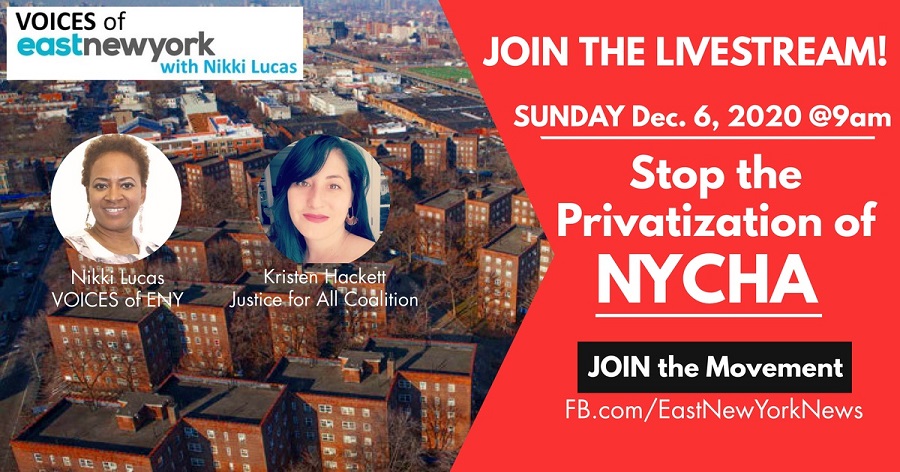
City Officials Speeding Up Privatization of NYCHA Which Will Displace Thousands of Tenants: How We Can ‘Halt The Blueprint’ Sunday Dec 6 on VOICES of East New York

NYCHA is trying to move forward with their Blueprint privatization plan at breakneck speed. This plan, along with RAD, ends public housing in NYC. (Read article about all 3 NYCHA Privatization Plans)
But it CAN be stopped. If state legislators vote no, this plan is stopped in its tracks.
One of the challenges to this task is getting accurate information out about the Blueprint, and making sure folks know how they can take action.
To this end, VOICES of East New York with Nikki Lucas will focus this weekend’s show on stopping the further distribution of NYCHA properties to private developers. East New York is one of the neighborhoods where private developers have been handed two NYCHA developments. (Read how it happened)
Let’s be crystal clear; management of NYCHA by private developers will absolutely speed up gentrification and will quickly push NYCHA rents to market rate.  Yes, you read that correctly!  Rents will go to market rate within 2 years.  If you do not qualify for Section 8 be prepared to pay market rate rent for your NYCHA apartment.  Market rate rent in Brooklyn for a 1-2 bedroom according to Rent Cafe is $2,951. This is how gentrification happens.  If NYCHA apartments are going to be market rate then the rest of the available apartments in East New York will demand even higher rents.
Kristen Hackett of the Justice for All Coalition will be this week’s guest to explain in detail the NYCHA Blueprint and how we can #HaltTheBlueprint. (Download the Blueprint Here) NYCHA Privatization Blueprint Plan
Watch and Join the Livestream Sunday Dec. 6 at 9am at Facebook.com/EastNewYorkNews

RELATED NYCHA NEWS

Continue reading

Events

Enjoy An Intimate Dining Experience with Live Background Music At Fusion East With Social Distancing Tuesday Dec 8

Fusion East Restaurant is providing an intimate dining experience with live background music, Tuesday Dec. 8, 2020 from 6pm-8pm. To adhere to strict social distancing rules you are encouraged to call to make a reservation.

Fusion East will be adhering to New York City social distancing rules, which allows 25% capacity for indoor dining. This rule makes the experience intimate with a small number of people, enjoying the dining experience with the live background music.

Fusion East is located at 1179 Elton St. Brooklyn NY 11239, just steps from the Gateway Mall entrance on the Elton St side.

Call Fusion East Today to Reserve a Table – (718) 975-5065 or email

Continue reading